Adapted with permission from: Baldwin, B.R., A. Biernacki, J. Blair, M.P. Purchase, J.M. Baker, K. Sublette, G. Davis, and D. Ogles. 2010. "Monitoring geneA segment of DNA containing the code for a protein, transfer RNA, or ribosomal RNA molecule (based on Madigan et al. 2010). expression to evaluate oxygen infusion at a gasoline-contaminated site." Environmental Science & Technology 44(17): 6829-6834. Copyright 2010 American Chemical Society.
EMD Technology
Contacts
Dora Ogles
Microbial Insights, Inc.
(865) 573-8188
The site is an operating gasoline station located in northern California.The shallow aquifer is impacted by petroleum hydrocarbons, including benzene, toluene, ethylbenzene, and xylenes (BTEX) along with the fuel oxygenate methyl tertiary-butyl ether (MTBE).
Examination of groundwater geochemical parameters (such as dissolved oxygen, nitrate, ferrous iron, sulfate) indicated highly anaerobic conditions. Although biodegradationA process by which microorganisms transform or alter (through metabolic or enzymatic action) the structure of chemicals introduced into the environment (USEPA 2011). of BTEX and MTBE has been well documented under anaerobic conditions, historical trends in contaminant concentrations led stakeholders to believe that monitored natural attenuation (MNA) would not provide site closure within an acceptable timeframe.
An oxygen infusion system was installed in the vicinity of the dispenser islands to promote aerobic biodegradation of BTEX and MTBE. The oxygen infusion system consisted of oxygen cylinders, 2-stage regulators, manifolds, and in-well emitters (iSOC, inVenture Technologies, ON Canada; and Waterloo, Solonist, ON, Canada). For the original system, a three oxygen infusion wells (IP-1 through IP-3) and two downgradient monitoring points (MP-1 and MP-2) were installed at the site.
RT-qPCR was performed to quantify the expression of toluene dioxygenase (TOD) and phenol hydroxylase (PHE) genes as well as Methylibium petroleiphilum PM1 16S rRNAA subunit of the ribosome composed of ribonucleic acid (RNA). The RNA sequence is used to classify and identify microorganisms (e.g. genus and species). to address the following question: Will oxygen infusion stimulate activityRefers to when a microorganism performs a specific function (e.g., sulfate reduction, metabolism of benzene) of benzene and MTBE degrading microorganisms at the infusion point and downgradient locations?
Pure oxygen was infused through emitters installed in wells IP-1 through IP-3. Dissolved oxygen (DO) concentrations were measured periodically at the injection points and downgradient monitoring points MP-1 and MP-2 throughout system operation. Standard, unamended Bio-Traps® deployed in the injection point IP-3 and downgradient wells MP-1 and MP-2 were recovered for RT-qPCR quantification of the following:
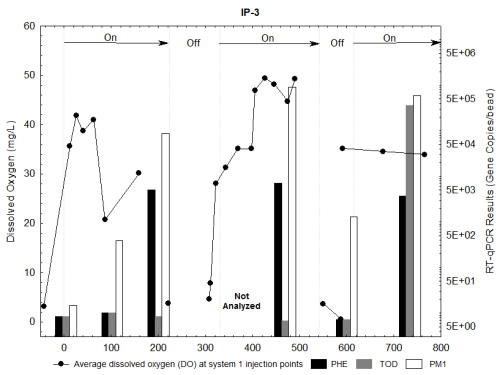
As discussed in detail in Baldwin et al. 2010, the impact of system operation at the oxygen infusion point can be summarized as described below (see Figure A.6-1):
Figure A.6-1. RT-qPCR results for quantification of M. petroleiphlilum 16S rRNA and expression of phenol hydroxylase and toluene dioxygenase genes at the oxygen infusion point IP-3.
Source: Adapted with permission from Baldwin, B.R., A. Biernacki, J. Blair, M.P. Purchase, J.M. Baker, K. Sublette, G. Davis, and D. Ogles. 2010. Monitoring gene expression to evaluate oxygen infusion at a gasoline-contaminated site. Environmental Science & Technology 44(17): 6829-6834. Copyright 2010 American Chemical Society.
While RT-qPCR demonstrated stimulation of aerobic BTEX and MTBE degraders at the infusion point, questions remained regarding the radius of influence of the system. As discussed in detail in Baldwin et al. 2010, RT-qPCR results also demonstrated that system operation stimulated activity of BTEX and MTBE degrading bacteria at the downgradient wells MP-1 and MP-2 even though DO levels remained low (Figure A.6-2A and B).
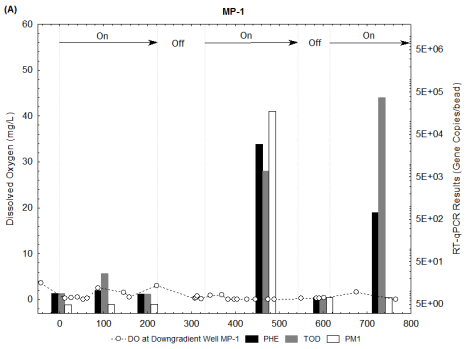
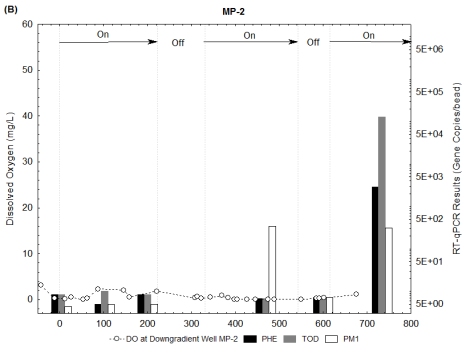
Figure A.6-2. RT-qPCR results for quantification of M. petroleiphlilum 16S rRNA and expression of phenol hydroxylase and toluene dioxygenase genes at downgradient monitoring points MP-1 (A) and MP-2 (B).
Source: Adapted with permission from Baldwin, B.R., A. Biernacki, J. Blair, M.P. Purchase, J.M. Baker, K. Sublette, G. Davis, and D. Ogles. 2010. Monitoring gene expression to evaluate oxygen infusion at a gasoline-contaminated site. Environmental Science & Technology 44(17): 6829-6834. Copyright 2010 American Chemical Society.
RT-qPCR analysis provided site managers with rapid feedback (7-10 day turnaround time) on the effect of system operation on BTEX and MTBE degrader activity before trends in contaminant concentration would have been evident. Ultimately, the changes in contaminant concentrations were consistent with the RT-qPCR results demonstrating aerobic BTEX degrader activity.
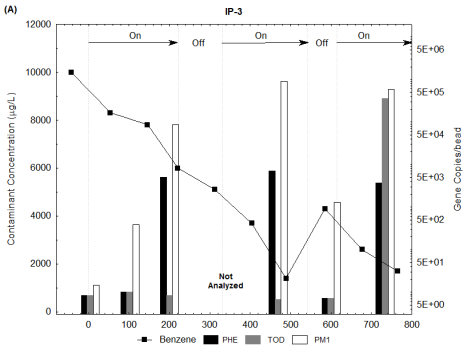
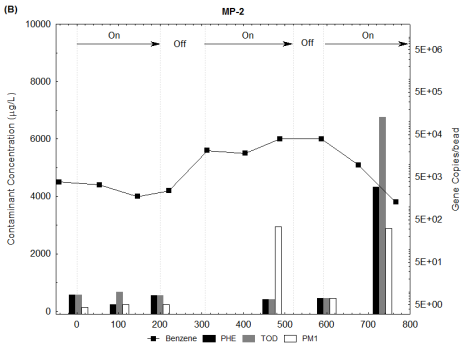
Figure A.6-3. RT-qPCR results and dissolved benzene concentrations at the oxygen infusion point IP-3 (A) and downgradient monitoring point MP-2 (B).
Source: Adapted with permission from Baldwin, B.R., A. Biernacki, J. Blair, M.P. Purchase, J.M. Baker, K. Sublette, G. Davis, and D. Ogles. 2010. Monitoring gene expression to evaluate oxygen infusion at a gasoline-contaminated site. Environmental Science & Technology 44(17): 6829-6834. Copyright 2010 American Chemical Society.
The following conclusions can be drawn based on the results for this site:
Continued RT-qPCR monitoring of TOD and PHE expression along with PM1 16S rRNA (three target genes) would cost approximately $575 per sample.
Baldwin, B.R., A. Biernacki, J. Blair, M.P. Purchase, J.M. Baker, K. Sublette, G. Davis, and D. Ogles. 2010. "Monitoring gene expression to evaluate oxygen infusion at a gasoline-contaminated site." Environmental Science & Technology 44(17):6829-6834.